
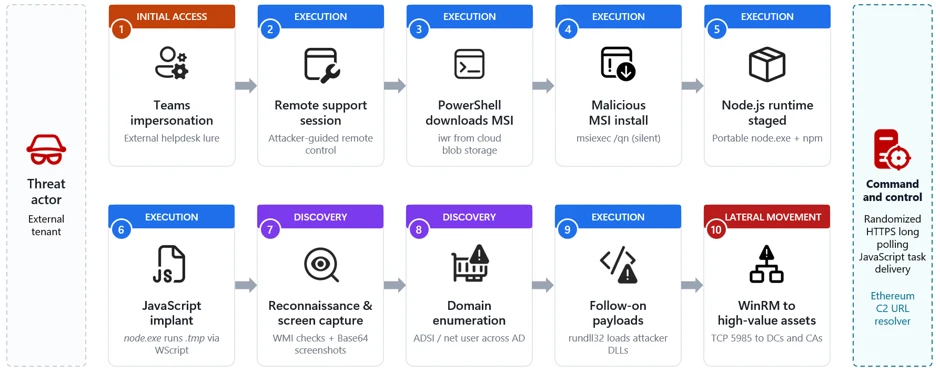
Microsoft Threat Intelligence has observed a human-operated intrusion campaign that abuses Microsoft Teams external collaboration to impersonate IT or helpdesk personnel and socially engineer users into granting an interactive remote session. Once remote control is established via RMM tools, the threat actor uses PowerShell to download and silently install a malicious MSI package, which in turn stages a portable Node.js runtime and an obfuscated JavaScript implant that provides persistent command execution and command and control (C2).
Unlike commodity phishing that ends with an infostealer, this campaign follows a full hands-on-keyboard playbook. After the implant is deployed, the threat actor performs extensive host and Active Directory reconnaissance, periodically captures screenshots of the victim’s desktop, executes follow-on payloads through trusted Windows binaries, and pivots across the enterprise over Windows Remote Management (WinRM) toward high-value assets such as domain controllers. The intrusion relies heavily on legitimate tooling, including Microsoft Teams, remote support software, Windows Installer, Node.js, and native administrative protocols, allowing the activity to blend into expected enterprise operations at nearly every stage.
This intrusion pattern is especially high-impact because it hands an external operator credential-backed, interactive access to internal infrastructure. The reconnaissance and lateral movement patterns observed: domain enumeration, server discovery, and WinRM pivoting toward identity systems, are consistent with intrusion activity that can precede data theft, extortion, ransomware deployment, or other follow-on objectives, in which threat actors map the environment, escalate privileges, disable security controls, exfiltrate business-relevant data, and ultimately deploy ransomware across the organization.
In this blog, we share our analysis of this attack chain, from initial Microsoft Teams contact through internal lateral movement, along with mitigation and hunting guidance to help defenders detect and disrupt this user-initiated access pathway before it escalates into broader compromise.
Risk to enterprise environments
By abusing enterprise collaboration workflows instead of traditional email-based phishing, the threat actor initiates contact through Microsoft Teams in a way that appears consistent with routine IT support. Microsoft Teams applies multiple security controls at the point of first external contact, including external tenant labeling, Accept/Block prompts, message previews, and phishing indicators, but this attack chain depends on convincing the user to bypass those warnings and voluntarily grant remote access through legitimate support tools.
An approved external Teams interaction, followed by a remote session, can enable the threat actor to:
-
Source: Microsoft Security Blog