
MacSync Stealer is a macOS-focused information stealer that relies on changing infrastructure to deliver payloads, communicate with compromised devices, and exfiltrate data. Earlier reporting by RST Cloud identified the threat through a limited set of domains and documented rapid command-and-control (C2) replacement after public disclosure.
Microsoft Defender Experts expanded that view by correlating recurring endpoints and network behaviors across the activity. This behavior-led approach connected more than 30 domains and showed that the infrastructure supported more than C2 communication, extending into active collection, staging, and exfiltration. The findings demonstrate that although domains may rotate quickly, repeated execution patterns, request characteristics, staging behavior, and upload methods provide defenders with more durable opportunities to investigate MacSync Stealer activity.
Activity overview
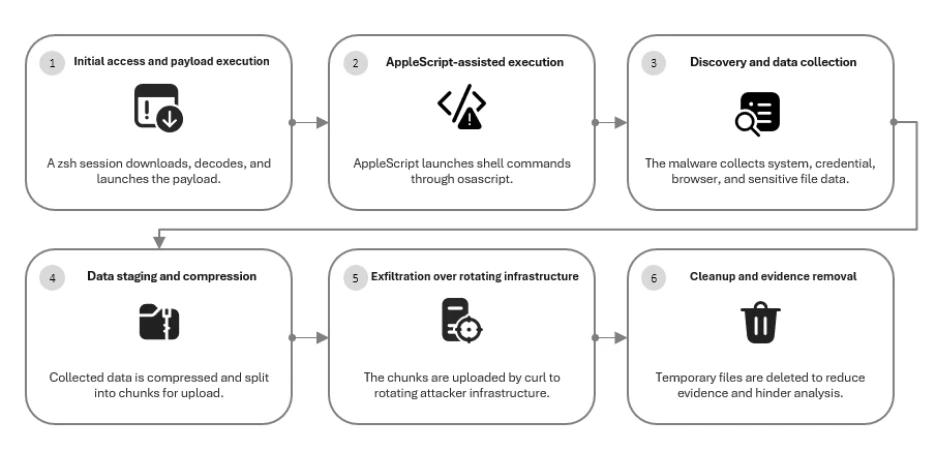
Microsoft Defender Experts reviewed endpoint and network telemetry to determine which MacSync Stealer behaviors persisted as infrastructure changed. The investigation followed the activity from C2 communication through collection, staging, and exfiltration, using recurring technical traits to connect activity across rotating domains. Execution began from an interactive shell session consistent with ClickFix social engineering, where users are tricked into pasting or running commands in Terminal. The shell session used curl to retrieve attacker-controlled payload content, followed by script-driven execution and outbound communication.
After execution, the malware communicated with attacker-controlled infrastructure using recurring URI paths, macOS User-Agent strings, API-key headers, and curl command-line options. These request traits became durable behavioral pivots because they remained consistent even as domains changed. The activity then progressed into collection behavior targeting macOS Keychain material, browser data, locally stored credentials, cloud and Secure Shell (SSH) credentials, and sensitive files from common user directories.
The investigation also confirmed active data exfiltration, not just beaconing. Collected data was staged under temporary paths, compressed into an archive, split into chunks, and uploaded through HTTP PUT requests using curl with the –data-binary argument. Upload parameters such as upload_id, chunk_index, and total_chunks provided additional hunting opportunities that coul